Super B and Rosalind

Super B and Rosalind
Click on the picture and see Super B in action in another outfit.

Monday, April 18, 2016

Writing A Limerick Is Your Task


There was an old man with a beard
Who said, "it’s just how I feared!
Two owls and a hen
Four larks and a wren
Have all built their nests in my beard.
                                -      Anonymous


National Poetry Month continues and so does the healing from my back surgery! Many of you put your toe in the water of creativity with your haikus - thank you. The very best was from Makenzie Ryals who aptly describes the very weak hydrogen bond:

Hydrogen bonding
Electrostatic partners
“O!,” “H!,” stop flirting.

Unfortunately the best physics one was a serious lament by Rachel Jones:

Physics makes me cry
Physics makes me wanna die
I hate physics so.

If you go and read this link, you can read all about limericks. Let us make this at least of the level of a lady being present to read them (some can be quite bawdy). They are, of course, five lines, with the abba rhyme scheme. 

One of my favorites is about the daughter who eloped and took her dad's bucket full of money:

There was an Old Man of Nantucket
Who kept all his cash in a bucket.
His daughter, called Nan,
Ran away with a man,
And as for the bucket, Nantucket.
                                              - Anonymous

Chemistry students, write yours about balancing chemical equations or naming chemical compounds and quantities. Physics, write yours about sound or universal gravitation.

Here is my attempt:

There was a chemistry teacher at Kosciusko,
Who made students learn deeper than one momento.
They kicked and they bucked.
They got their parents riled up and even said he sucked.
Now some see the show and actually know.
-Super B

Happy Limericking!  If there are any others actually reading this blog, feel free to summit yours as well.

Wednesday, April 13, 2016

Write a Science Haiku for you, for me, for the world


This is national poetry month - let us make our contribution. It is April and T.S. Elliot penned in The Waste Land: 
APRIL is the cruellest month, breeding
Lilacs out of the dead land, mixing
Memory and desire, stirring
Dull roots with spring rain.


Let us do our mixing and stirring up of memory and desire.


For inspiration:

  1. Watch this video of a science process poem: 
  2. Read and watch the embedded videos in this article from symmetry magazine (Note the quote:Science is inevitable; art is fragile. Without Einstein it may have taken many, many years, and many people working on it, but we still would have come up with his theories. If Beethoven died at age 5, we would not have the sonatas; art is not repeatable.
Here is mine for chemistry:

A tight rope artist 
Walks chemistry equations 
yet she never falls.

And for physics:

Sound is vibration
Changing pressure changing media
Drowning out and delighting.

Post yours as a comment.

Saturday, March 19, 2016

How Many Moles of Chalk Does It Take To Draw a Periodic Table?


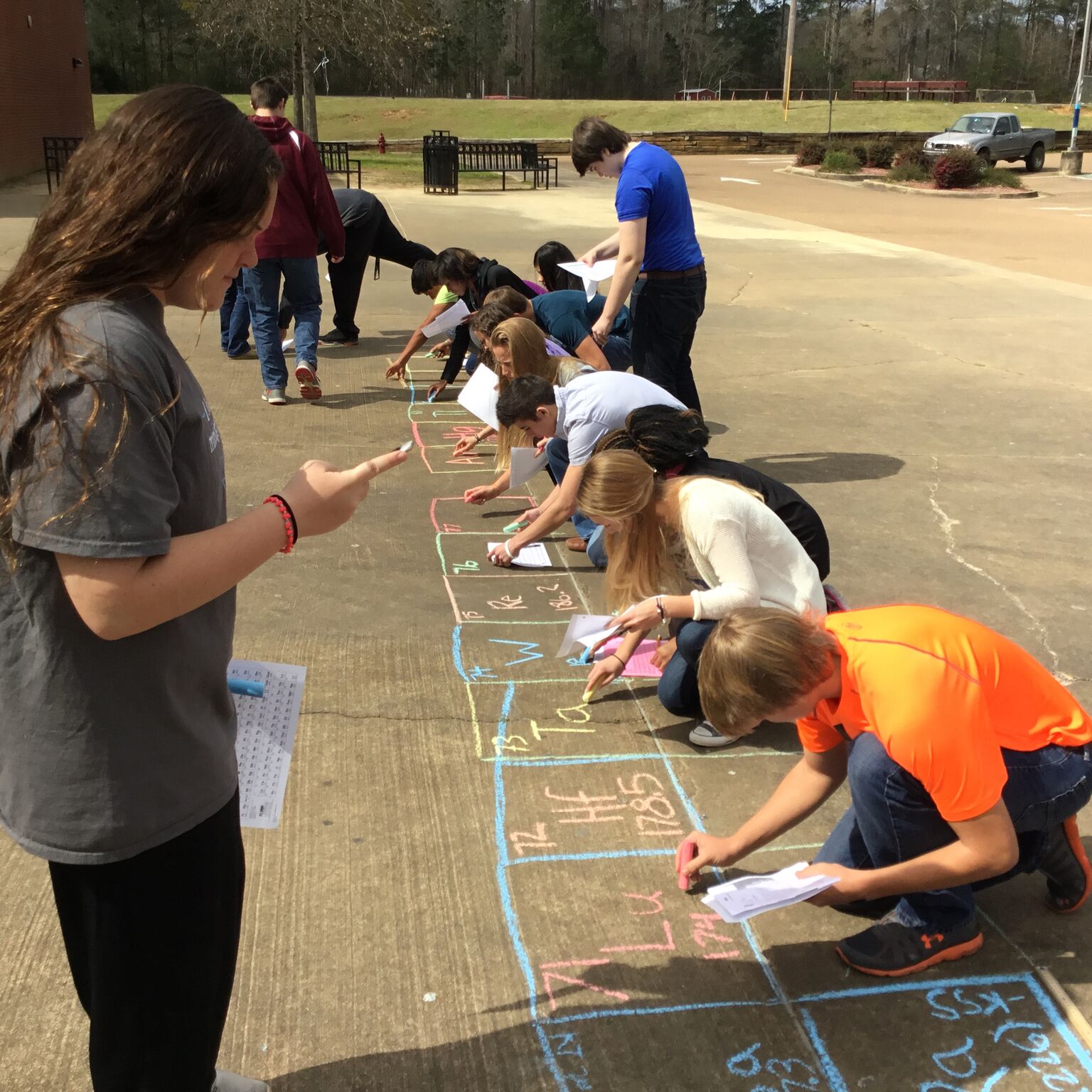
Chalk is Calcium Carbonate (CaCO3). The molar mass is easily found from the atomic masses of the elements in the formula unit (100.7 g). Each student massed their chalk and then drew the square for their assigned element and wrote the atomic number, symbol and atomic mass in it. 

Upon return to the classroom, a new mass was found and the mass used was calculated by subtraction. Divide that mass by the molar mass and voila - Mole used. We then found the mass used by the class and then by all four of my chemistry classes. (around 2 moles).


Which of your eyes is dominant?


Let us try a little experiment to see if anyone is really reading this blog.

Go to Science Friday one of my favorite sites
 
Follow the steps, then make a comment about whether you are right or left handed and left or right eyed.

Enjoy. By the way, I am right handed and right eyed and my wife does not have a dominant eye and is right handed.

Friday, March 18, 2016

Down But Not Out


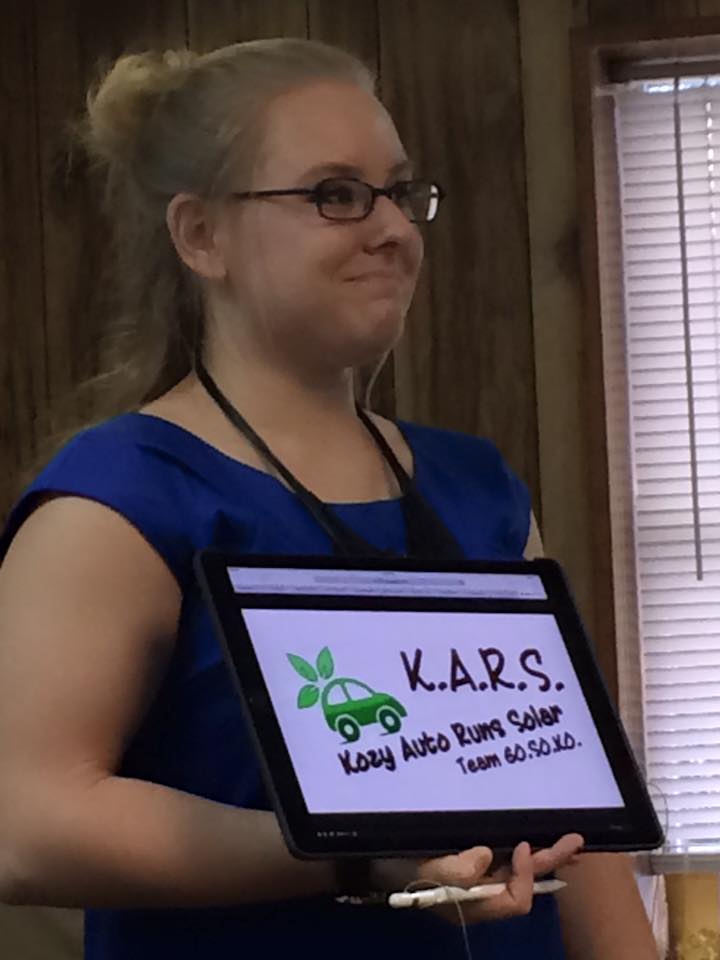
It was on a Sunday afternoon - the same time we had met as a Solar Car team for months. It was decision time. On the following Tuesday our 21 page application and $1500 entry fee were due. I asked how many would be able to make the race July 14-23 - sadly, only four could commit. After all this time, we decided not to enter the race. It was one of the saddest days of my teaching career. Everyone looked so crestfallen and defeated. We went home.

I had a good night's sleep and woke up the next day with a new fire in my belly. We had come to far to give up now. I actively recruited some more students - now we have nine that have signed on the line. On Tuesday we sent in our application.


We are back in the race!

At Hunter Engineering: Fr. Dusty Moss Joseph Davide Hannah Thornton Tyriq Martin
Br Wayne Bowling, Rodney Vance, Mike Howard (plant manager) Ken Lowery

The very hard work of my students raised the funds for our entry fee. Hannah Thornton, Angel Garcia and Dusty Moss made a lot of contacts and developed sponsor sheets.
Additionally, Hannah professionally put together a power point presentation. Joseph Davide, Tyriq Martin, Dusty Moss and Hannah Thornton presented our project on two occasions - one at Hunter Engineering


and another at the monthly meeting of the Kosciusko Lion's Club.
Hannah Thornton


Joseph Davide


We had a logo contest and  it was won by Ms. Cain's class and we used the logo on our T-shirt. We sold T-shirts, designed and printed by one of our student's mom, Peggy Davide! They are still available for purchase. 

We also had a bake sale.

With all of these efforts we have raised over 2200 dollars. (A list of sponsors will appear in the next Solar Car Challenge blog).

Team of Engineers from Hunter Engineers with our engineers.
Now that we had enough money to start, Hunter Engineering sent out their mechanical engineer, David Dennis, and his two assistants. After helping us with the design and listening carefully to our plans, they decided to order us some steel for the frame and some sheet metal for the skin. They also are looking for recycled parts. It was a great day of collaboration and brainstorming with engineers and future engineers. They will build our suspension to our specification. We are on our way. They promised to come back and help as needed.


Everything was in place accept a place. We looked all around to find a home for our Solar Car Challenge. Hunter needed an address to deliver the steel. We needed a place to start building. Then after a phone conversation and initial query, in walks Jenny Cook into my room. She and Art are letting us use their building across from the Vo-tech. Wow! Thank you, Jenny and Art, for being great supporting of education in Kosciusko.

Here are a few shots of our work on the mock-up of our car at our new home.


Joseph Davide, Tyriq Martin, Ray Ferguson, JB Vazquez and Jonathan Cruz

Stay tuned for our progress.


Monday, March 14, 2016

Kosciusko Science makes an entrance . . .

Joseph Davide, a sophomore, and Cailyn Pope, senior.
These two brave students submitted their papers to the Mississippi Junior Science and Humanities Symposium, and they were accepted for presentation. I was incredibly proud as I heard them present their original research at St. Andrews Episcopal School in Ridgeland, Mississippi on March 4.

Joseph's research was entitled, Blue Energy. He made a solar cell using blueberries and titanium (IV) oxide from sunscreen. Cailyn's research was entitled, Miracle Berry Taste Test. She tested how long the miracle berry effected sour taste buds. After eating the miracle berry tablet lemons taste sweet. 

This was our first foray into this competition from Kosciusko. I have taken many of my students to this excellent symposium over the course of my career. Last Friday was unquestionably one of my proudest moments as a teacher. 

As we left on the bus, I told the fifteen students who went to observe that I expected them to be on the bus next years with their presentations in hand.


When we got to St. Andrews, we were awed by the fresh, modern look of the campus. It is all state of the art. In the lobby of the science building there was a foucalt pendulum and a water wall with an etching of Leonard de Vinci's Vitruvian Man.

The lecture hall was a very impressive, and we were greeted with great hospitality.


We got to hear four scientists on a panel discuss both their career trajectory - how they got to where they are now- and their research interests.  We heard from Glake Hill, a chemist at Jackson State University, who does DNA research. George Moncreif, a supercomputer expert with the Corp of Engineers. Bill Grogan, a civil engineer specialist on road and runway pavements also at the Corp. And Ryan Gaitin, a PhD candidate with a passion for music and neuroscience.

As the awards began, Buck Cooper the director of the event said, "the judges voted on the teacher award of $500 to honor a teacher who has done particularly noteworthy work or made a uniquely strong contribution in terms of mentoring students in the conduct of original scientific research. The award goes to John Banks." There have been few times in my life when I have been so completely shocked and surprised!

Then he started announcing the five winners of the paper competition - all of whom will receive an all-expense paid trip to the National Junior Science and Humanities Symposium in Dayton, Ohio, from April 27-30.

When we got there we found out the other presenters had university mentors for their projects and the students worked in their mentor's labs to do their research. Given this situation, I thought we had no chance for any awards. When they announced the fifth place winner and it was not one of my students, I thought we all would just have a good experience and go home. To my surprise and delight, Joseph Davide, was announced as the fourth place winner,
and he was the only sophomore among the other four seniors.

Great things are in store for us in the future. Kosciusko made a grand entrance into our first Junior Science and Humanities Symposium.  And had great fun doing it.


My physics student who is from Argentina, Pierina Fraire.

Tamare Greenlee, Ilse Padilla, Makala Hutchison,  JB Vazquez, Super B, Cailyn Pope, and Pierina Fraire

Tamara Greenlee and Makala Hutchison


Sunday, March 6, 2016

A Whole Lot of Science

l to r: Hunter Ballard, Third Place Write It Do It, Second Place Green Generation; Miguel Garcia, Second Place Anatomy, Second Place Disease Detectives; Makayla Montz, Second Place Anatomy, Second Place Disease Detectives; Riley Watson, Second Place Green Generation; Kevin Moore, Third Place Write It Do It


Science Olympiad Team 2016  l to r: Joseph Davide, Miguel Garcia, Osvaldo Ballesteros - Captain, Hunter Ballard, Riley Watson, Makayla Montz, Kevin Moore. Front: John R. Banks and Kristi McElwain, sponsors


I have been absent from my blog for quite awhile. For good reason. I have been motivating, cajoling and, yes, bribing students with test grade 100's to participate in our first science fair in 20 plus years (62 different individual and group projects) at our school, January 21, 2016.

And . . .
  • our first regional science fair at Mississippi State University, Starkville, MS on February 23, 2016. 

  • our first entries in the Mississippi Junior Academy of Sciences Paper Competition at St. Andrews Episcopal School, Ridgeland, Mississippi on March 4, 2016, Cailyn Pope and Joseph Davide.

  • our first student to be selected to attend the National Junior Academy of Sciences Symposium in Dayton, OH on April 27-30. Joseph Davide, sophomore. 


  • our first four submissions in the Exploravision national competition submitted online, February 6, 2016. We did not win any awards but the experience was invaluable, and future students will benefit from their initial efforts.


  • our first try at the regional Science Olympiad competition at the University of Mississippi, Oxford, MS on March 5, 2015

Through it all I have been so proud to see my students exert an incredible effort to do good science. Good science is all about asking good questions and using creative and methodical ways to find answers and then repeating the process over and over again. I call it the confusion/clarity cycle.

Teachers and parents and community members before me have fostered and developed great young scientists, and I tip my hat to them all.

MORE TO COME SOON.